The Soul in the Machine: Navigating the Legal Chaos of AI Music
With AI-generated tracks topping the charts, a new legal frontier has emerged. Understanding the shift from 'fair use' to 'human certification' is no longer optional for creators.
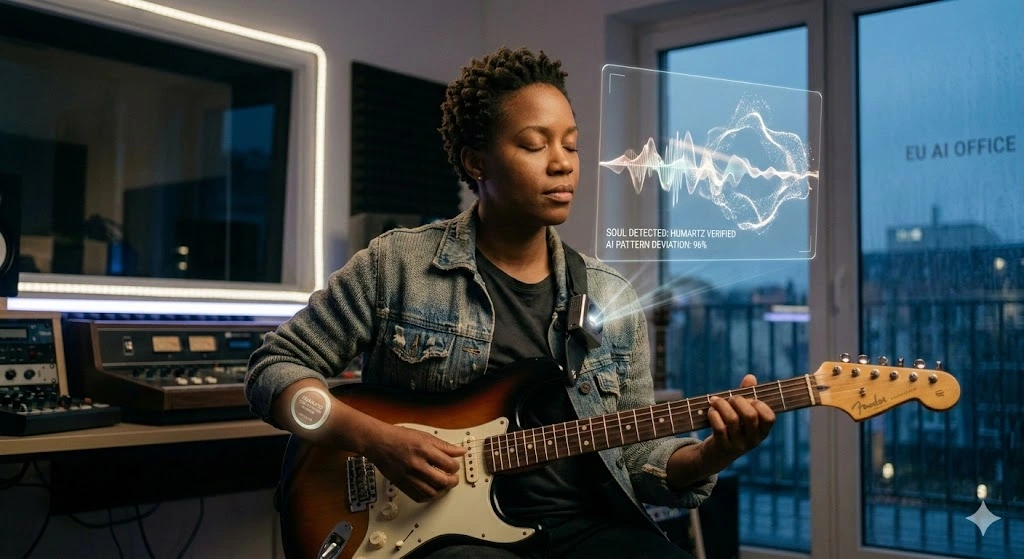
A curious thing happened recently on the Billboard Country Digital Song Sales Chart. A track called "Walk My Walk" hit the top. It had the right grit, the right twang, and the right production. There was only one catch: the artist, Breaking Rust, was an AI.
As Bloomberg Law recently detailed, we aren't just looking at a technological novelty anymore; we are looking at a fundamental shift in how music is legally defined and commercially valued. The industry is currently locked in a high-stakes debate over whether AI can capture the 'soul' of an artist—but the legal quandaries are much less abstract.
The Three-Front War for Music Rights
For artists and labels, the rise of generative AI has opened three distinct legal battlefronts that threaten the traditional creative economy:
- Reproduction Rights: Training a model requires copying thousands of works. Rights holders argue this is infringement; AI companies argue it’s 'fair use.'
- The Derivative Trap: When an AI outputs a melody that mimics a human artist’s signature cadence, it crosses into the territory of unauthorized derivative works.
- The Distribution Dilemma: Platforms hosting AI-created audio are facing potential liability for downstream public distribution of unlicensed content.
From 'Scraping' to 'Certification'
We are seeing a move away from the 'Wild West' era of data scraping. Landmark transactions, such as the recent deals between the startup Klay and the three major music labels, suggest a new path: licensed training.
Instead of passive ingestion of source materials, the industry is moving toward rights-cleared catalogs. This shift is being codified by the EU AI Act, which now mandates that general-purpose AI models must be transparent about the content used for their training. For the first time, creators have a legal mechanism to 'opt-out' of the machine.
The Authorship Hurdle
Under current US law, copyright is reserved strictly for human authorship. A machine cannot own a copyright. This creates a massive 'grey market' for AI-assisted music. The challenge for 2026 is determining exactly where human input ends and technical support begins.
If you can’t prove the human provenance of a track, you risk losing the legal right to protect it.
The Humartz Standard
This is where the industry is bifurcating. On one side, we have infinite, unverified AI content. On the other, we have Certified Human Art.
At Humartz, we track these developments not just as observers, but as the infrastructure for the solution. By providing a verifiable audit trail of human creation, we allow artists to meet the transparency standards now being demanded by global regulators like the EU AI Office.
Certification isn't just about authenticity—it’s about enforceability. It provides the recordkeeping necessary to verify that a work is outside the bounds of AI training datasets and within the protections of human copyright law.
The Outlook
Innovation doesn't have to come at the expense of rights. As Bloomberg’s analysis suggests, the future of music involves licensed training, usage transparency, and robust consent mechanisms.
In a world where AI can mimic almost any sound, the most valuable thing an artist can possess is a verified human signature. It is the only thing the algorithm cannot replicate, and the only thing the law is designed to truly protect.
2026-03-14 · 6 min read
What Happens When AI Impersonates You Online — and How to Fight Back
AI-generated content is being posted under real artists' names, passed off as their work, and used to sell products they never endorsed. Here is what your options are.
2026-03-12 · 5 min read
How to Build a Portfolio That Proves Human Creativity
A portfolio used to be a showcase of finished work. In 2026, it needs to do more — it needs to demonstrate that a human made it. Here is how to build one that does both.
2026-03-10 · 5 min read
How to Price Your Human-Made Art in an AI World
AI has compressed prices at the bottom of the creative market. But the market for provably human creative work is developing a premium. Here is how to price into it.
Protect your creative legacy
Don't let your work disappear into the noise. Get a verified human badge that holds up legally and commercially.