How to Prove You Made Something Before AI Did
When your work gets contested, timestamps and gut feelings won't cut it. Here is what verifiable proof of human origin actually looks like — and how to build it.
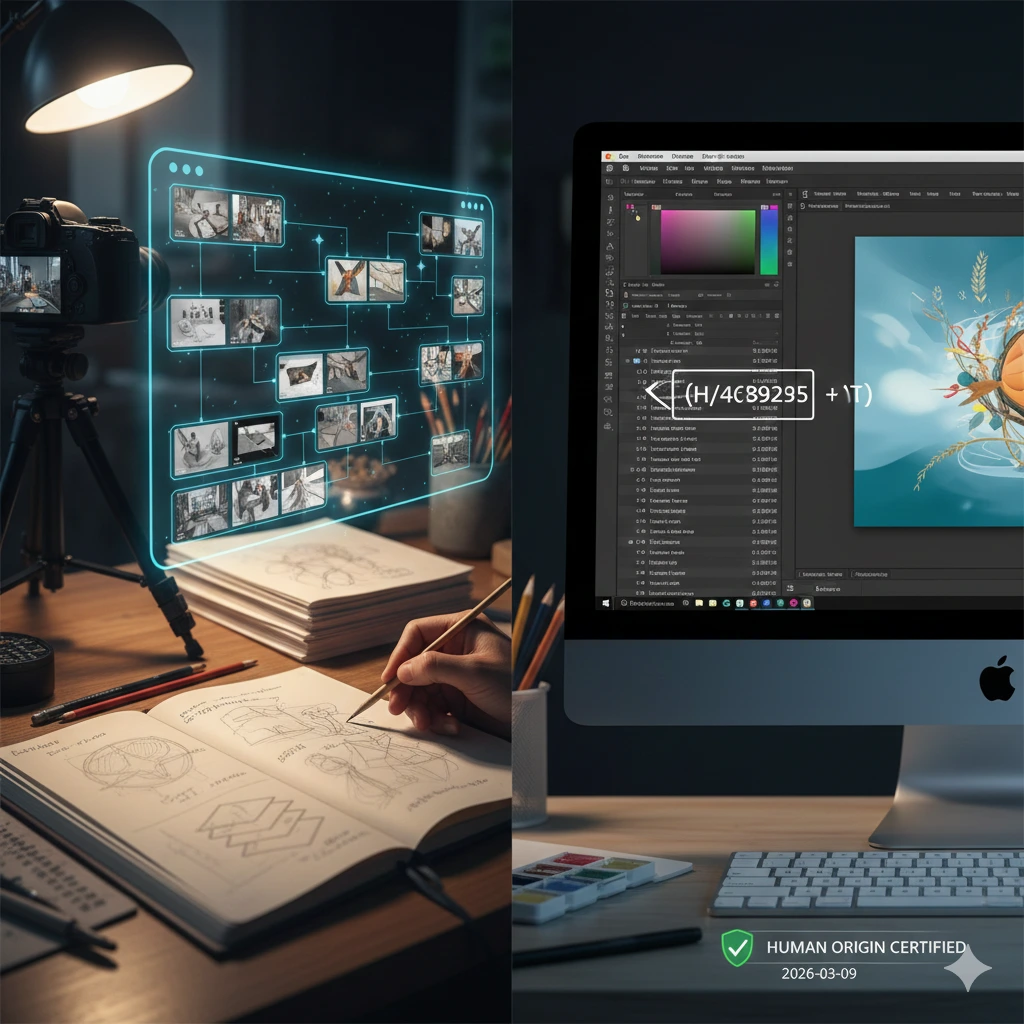
A graphic designer recently posted a thread that got shared tens of thousands of times. A client had accused her of submitting AI-generated work. She hadn't. But she couldn't prove it.
She had the final file. She had the invoice. What she didn't have was anything that documented the process — the sketches, the revision history, the hours of work that sat behind the polished deliverable. In the absence of evidence, the accusation stuck.
This is the new reality for working creatives. Proof of human origin is no longer a philosophical concept. It is a practical requirement.
Why "I Made It" Isn't Enough Anymore
For most of creative history, authorship was assumed. If you showed up with a painting, it was your painting. Forgery existed, but it was the exception. The burden of proof sat with anyone who claimed otherwise.
That assumption has inverted. AI can now produce work that is visually, sonically, and stylistically indistinguishable from human output. When a client, a platform, a court, or a regulator looks at your work, they can no longer assume human origin. The burden has shifted — quietly, without any formal announcement — onto the creator.
What Courts and Platforms Actually Accept
If you ever need to defend your work — in a contract dispute, a copyright claim, or a platform review — here is what actually holds up:
Timestamped process documentation. Version history, dated drafts, and layer files with embedded metadata establish a timeline of creation. A single polished file proves nothing. A sequence of files that shows how it evolved over hours or days tells a convincing story.
Third-party verification. Self-signed timestamps are easy to fake. A cryptographic hash of your work recorded by a neutral third party at a specific moment in time is far harder to dispute. Services that record not just the file but the creation sequence carry even more weight.
Platform-native history. If you work in tools that have automatic save history — Adobe Creative Cloud, Figma, Ableton — that history is stored server-side and is much harder to retroactively alter. It is worth knowing where that history lives and how to export it.
Witness and collaboration records. Emails, shared documents, and feedback threads that show a work evolving in real time, with other humans responding to it, establish context that is very difficult to fabricate.
The Forgery Problem in Reverse
Here is something counterintuitive: the same techniques used to detect art forgeries are now being applied to AI detection — and they face the same limitations.
Forensic art authentication relies on physical evidence: brushstroke analysis, pigment dating, canvas aging. For digital work, the equivalent is metadata analysis, pixel-level statistical patterns, and behavioral fingerprints. But just as forgers learn to mimic brushstrokes, AI models are being fine-tuned specifically to evade detection tools.
This is why the detection approach is fundamentally reactive. By the time a detection tool can identify a new model's outputs, that model has already been deployed at scale.
The only approach that isn't reactive is establishing provenance before the work enters the world — not trying to prove after the fact that something is human.
Building Your Evidence Trail
The practical habits that protect you:
- Save obsessively and with timestamps. Every meaningful stage of a work, not just milestones.
- Record process video. A time-lapse of your screen while you work costs nothing and is nearly impossible to fake convincingly.
- Use tools that automatically log history. Know where your cloud-based version history lives.
- Get your process certified. A neutral third party that records the human creative process as it happens — not just the output — gives you something no detection tool can replicate: positive proof, not just the absence of AI signals.
The Shift Already Happening
Major stock platforms have started requiring artists to declare whether work is AI-generated. Several publishers now ask for process documentation alongside submissions. Advertising agencies are beginning to require certification for work that will be used commercially.
This is early. Within two years, process documentation will likely be a standard requirement across most professional creative contexts.
The designers, musicians, and writers who build these habits now won't have to scramble when it becomes mandatory. They will already have the trail.
2026-03-14 · 6 min read
What Happens When AI Impersonates You Online — and How to Fight Back
AI-generated content is being posted under real artists' names, passed off as their work, and used to sell products they never endorsed. Here is what your options are.
2026-03-12 · 5 min read
How to Build a Portfolio That Proves Human Creativity
A portfolio used to be a showcase of finished work. In 2026, it needs to do more — it needs to demonstrate that a human made it. Here is how to build one that does both.
2026-03-10 · 5 min read
How to Price Your Human-Made Art in an AI World
AI has compressed prices at the bottom of the creative market. But the market for provably human creative work is developing a premium. Here is how to price into it.
Protect your creative legacy
Don't let your work disappear into the noise. Get a verified human badge that holds up legally and commercially.